Follow along with the video below to see how to install our site as a web app on your home screen.
Note: This feature may not be available in some browsers.
We are officially moved over to Discourse. Autoflower Discourse"
You will have to create a new login for the new site!
This current Xenforo-based forum will be preserved as a read-only archive going forward with efforts to better categorize and tag original and canonical content.
The URL autoflower.org will soon point to the new Discourse site; so we'll be back to business in a few days!
Send Son of Hobbes a private message if you have any questions!
Hey Trifid, my girls love the freeze/thaw kelp extract foliar. I do too. Thank you very much for that!
If I did a 50:50 kelp/alfalfa freeze thaw extract would it be nitrogen overkill? Well not overkill, but would it be beneficial or just wasted time grinding alfalfa pellets that could be better used tucking leaves?
(my RA is kickin' some ass and I'm tucking all over the place with her. )
When dealing with mixtures of crude products it is recommended that you prepare a serial dilution (50%, 25%, 12.5%, <7%, <3.5%, <2%..) of a stock suspension not exceeding a 1:9 ratio of raw material to distilled water - prepare the stock to super-saturation by warming the suspension (<40C) to reach a solubility maximum, precipitating-out the excess salts by cooling and collecting them by filtration. Since it is difficult to determine the absolute concentration of the macro-nutrients in your stock, you can approach the maximum threshold using a consistent dilution factor at each step in the dilution series – this results in a geometric progression of the concentration in a logarithmic fashion.
If you're using EC to approximate the macro-nutrient concentration be sure to standardize your readings - since recommended EC values are usually given for fertilizers in pure distilled water, the irrigation EC must be subtracted from the solution EC. Obtain the EC for each dilution and subtract them from the your water EC (usually 0.5 mS/cm) and apply those within the range of 0.5-1.8 mS/cm. Since the average NPK for Alfalfa meal is 2.8-.3-2.4 dilutions <7% should give approximate N concentrations somewhere in the range of 100 ppm while still providing an abundance of bio-active ingredients. If you are struggling to obtain an EC >0.5 you can add a micro-nutrient chelate such as Zinc @ 2.5 mg/ltr.
Thanks a ton for the info Trifid! Damn, but that's complicated. Oh well, I guess I just F'd that up then. But the girls loved the F-up anyway.
I was impatient for your answer and just powdered up my Alfalfa as fine as I could and added it to the Kelp powder and dist. water. Did up the freeze/thaw procedure and gave them a shower. They liked it and they're growing like they are loving life, so I guess it was ok!
Thanks for the help!
Glad to hear its working for you Noods. Sorry if i've bombarded you with too much information - this is just the way i do it.. Did you filter of the excess solid? (this help minimize unnecessary residues). As long as you are keeping the ratio to distilled water reasonable and diluting the stock to at least 10% its unlikely to be nitrogen overkill..
Hey buddy, please keep up the bombardment! It's fine to hear, "Do this to have that effect at a specific time..", but to dissect it and learn the why and how of it all is a luxurious enrichment to my new-found hobby! :thumbs:
Yes, I separate the solids. Remember, the dirty leaves is why I was so interested in your method. It works a charm! I used 10 ml solution in 500 ml water with about 10 ml diluted lemony fresh added (1 drop:~400ml).
I wonder if my plants' knowing that this foliar is coming from a Triffid's kitchen is keeping them on their toes and making them nervous about showing any signs of depression... They sure are looking like they want nothing more than to please.
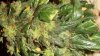
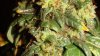
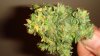
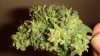
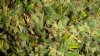
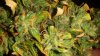
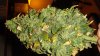
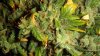
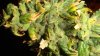
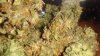
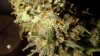
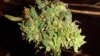
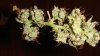
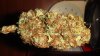
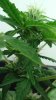
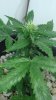
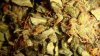
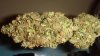
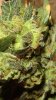
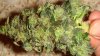
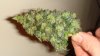
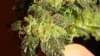
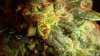
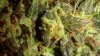
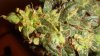
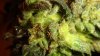
Here's some harvest material from the 1st tier The curing cabinet was sterilized prior to use with 17% hydrogen peroxide spray and preheated to eliminate any ambient moisture - cabinet temperatures were in the range of 20-24C with an ambient humidity no greater than 30% - the drying period was interrupted following a net reduction in wet-wt of 75% and the floral clusters placed into jars for curing burping when necessary to maintain a humidity of 65%.
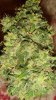
BlueHimalayanKush 82 days - Pre-cure
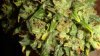
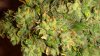
BlueHimalayanKush 82 days - 12 day cure
The BlueHimalayanKush was taken over a period of a week at 82 days. The primary cola was harvested first upon maturity as indicated by the browning of accessory leaves and darkening of the calyx - dried for six days and placed into the curing jar. The lateral colas produced the more aromatic resins (caramel/blueberry) and were dried for four days. The jars were burped periodically to maintain a humidity of 65% and were placed in storage after 12 days.
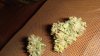
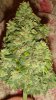
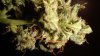
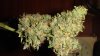
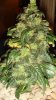
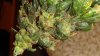
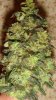
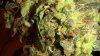
Bluematic day 84 - Pre cure
The Bluematic was harvested at day 84 and required minimal trimming - resin production was accelerated in the final week to give sour/blueberry aromas similar to the DP Blueberry parent. The floral clusters were dense and tight-packed but cured quickly to give a smokable product after only six days with minimal burping.
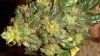
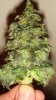
PineappleExpress 87 days - Post manicure (left). Bluematic day 80 - Pre-harvest (right)
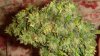
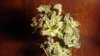
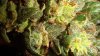
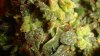
PineappleExpress (lateral cola) 87 days - Post manicure
PineappleExpress reached a uniform maturity on day 87 with a minor percentage of amber trichomes and was harvested over period of a few days. The product was only moderately resinous with a high leaf-calyx ratio and high cluster productivity. The citrus pineapple aroma was muted during the drying process but became immediately apparent after only six days into the cure where burping became less frequent.
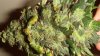
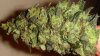
Smurfberry day 85 - Pre-harvest (left). Smurfberry 89 days - post manicure (right)
Smurfberry 89 days - post manicure
The Smurfberry gave the highest grade product at day 89 - the floral clusters compact and solid to the touch, frosty in appearance and pungent - the strong kerosine/licorice aromas are similar to the generic WhiteWidow. Despite producing only a very minor yield, the product was overwhelming to the senses during the manicure, accessory leaves were completely covered in trichomes and very sticky.
This site uses cookies to help personalise content, tailor your experience and to keep you logged in if you register.
By continuing to use this site, you are consenting to our use of cookies.